
Jasmeet Randhawa is a writer here at YPS; she writes personally on her medium as well, exploring the intersection between history and philosophy.
Remember remember the 5th of November- Gunpowder, Treason and Plot
Take a walk with me, back in time, back before the Age of Enlightenment, to a time when the Holy Roman Empire, with its dynastic tradition of marrying your sister, had led to one of the most inbred, yet powerful dynasties in the world- the Habsburgs, with their famous chins. A time before King Henry VIII had yet to start his lifelong hobby of marrying and killing his wives, still being married to Catherine of Aragon. A time when the word of God, spoken by the Pope, would either be a rallying cry to the masses, or an ominous warning to straighten up.
The whole of Europe divided it was in empires and territories, remained unified in faith, all bowing their heads to the Papacy in Rome, following Roman Catholic traditions and paying a sizeable church tithe.
And then Martin Luther nailed a piece of paper to the wall of a church and everyone hated each other.
Well, not quite.
It had been some time, since the Catholic church was waning in its influence; turns out people don’t trust you as much when you tell them you can save them from hell if they pay you a couple of gazillion bucks (give or take). Nor did the ego-laden heads of Kings, like the idea of bending the knee to some old geezer who claimed to be God’s representative on earth.
Thus, came Martin Luther, looking at the debauchery and bloodshed that had taken over the continuet. Fed up he was with people thinking they could “buy their way to heaven”, he preached his own gospel, issuing the revolutionary idea that you actually had to be a good person for God to like you, and not just rich.
From Luther’s action, began the dissolution of many nations and peoples from the church of Rome. From his philosophy, sprang not only Lutheranism, but Protestantism, Baptistism, Presybitarism, Anglicanism and a whole lot of other isms. You get the idea. Largely, these breaks from the Catholic Church are referred to as Protestant, lumping them together to basically mean not Catholic or Orthodox.
And of course, because this is the 16th century, the idea of these denominations co-existing in peace, was out of the question; as soon as they sprang up, so did the European Wars of Religion.
The European Wars of Religion- a conflict that you would think took place between different religions the world over, fighting for the true meaning of God, and in the name of defending their faith.
You would think, it would be a time of great meaning, in which the definition of religious identity took place, a true transformation in the souls of the followers of God, as they contended with what the one, true path might actually be.
In actuality, they were all Christian and were fighting over who got to collect taxes.
While that may be an oversimplification, it isn’t that far off of a description and gives you an idea of the absurdity of the war. At one point, during the Wars of Religion, Christians were allying with the Ottoman Muslims, against other Christians. Funny how that works.
Anyway, while I would love to tell you all the interesting tidbits of the Wars, from the time the English King went from being the Pope’s biggest fanboy to his most vehement hater- all because he wanted a new wife, or the true story behind the “Bloody Mary” urban folktale that absolutely terrified me as a kid, we are going to focus on an event that happened at the tail-end of this violent period: the 5th of November.
The Brits, have a nice rhyme composed to commemorate the day, and on the night of November 5th every year, you can see them lighting bonfires and burning effigies of Guy Fawkes (which, I have to say, is a very paganistic-esque ritual, for a tradition with so many connections to organized religion).
So, what happened?
The Virgin Queen, Queen Elizabeth I of England and Ireland, and Defender of the Anglican Christian faith had died, without heirs (which, given her epitaph, was not at all surprising). The Crown then passed to her Protestant Nephew/Cousin (don’t ask) James VI of Scotland, making him King James I of England (and James VI of Scotland, again don’t ask), which angered many of the Catholic members of the nation, having now to contend with the tradition of Protestantism becoming more and more entrenched within Great Britain.
The Catholic v. Protestant divide in England was a messy business, and it was actually rooted in King Henry VIII and his 6 wives, with the country breaking from the Roman Catholic tradition when he wanted to divorce his wife, but the Pope wouldn’t let him (there is a lot of political stuff surrounding the family of his first wife and their connections to the Pope, and some stuff about Spain and blah, blah, blah. It is very interesting, but it’s also very complicated, so we are mostly avoiding it for now).
Elizabeth had been Protestant but was also tolerant. Unlike her older sister, Bloody Mary, the last Catholic ruler, who had fried Protestants like shish-kebobs, she opted for a more secular approach of live and let live.
She had, however, faced significant threats from Catholic noblemen and plotters, who would rather a Catholic sit on the English throne, but ultimately had a long and mostly peaceful rule (save a couple of times she had to thwart some assassination attempts and one time she had to murder her cousin, who, fun fact, happened to be James’ mom! ).
King James, however, was not one to opt for such a passive tactic, reports and attitudes indicated that the man would take a more involved (violent) approach. This led to a rise in anxiety for the Catholic population, inspiring a few, more headstrong (stupid) men to take action in their own hands, by blowing up Parliament, and killing the royal family! (Interesting how the solution to the threat of possible violence, seems to be actual violence).
The plan was to kill all members of the royal family and save his baby daughter, Princess Elizabeth, who, at age 9, could be shaped into the perfect Catholic Queen. They also planned to blow up Parliament, killing high-ranking ministers, and have English Catholics take over Parliament.
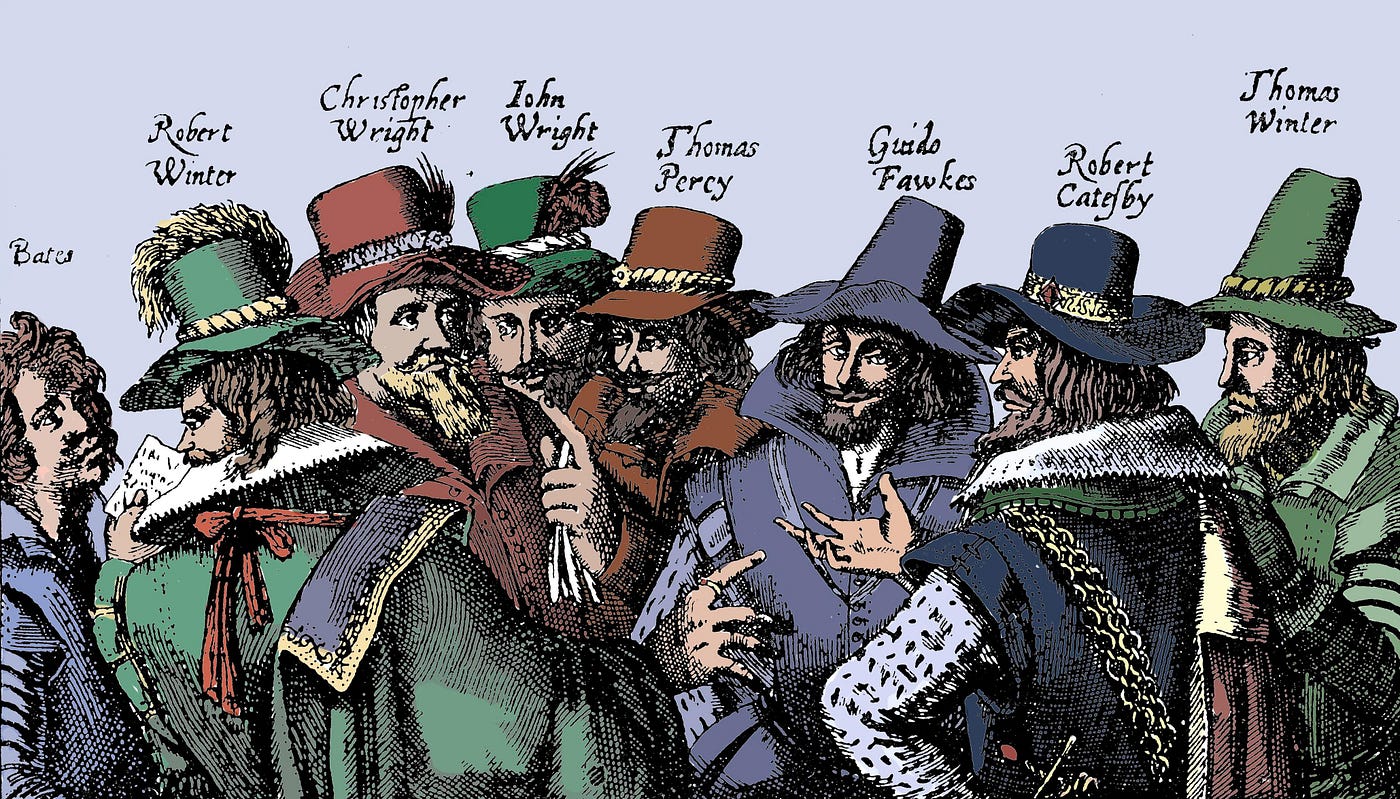
Guy Fawkes’ name is often synonymous with the plot, but the leader was actually Robert Catesby. His father, Sir William, was persecuted for refusing to conform to the Church of England’s new mandates, and both he and his son would devote their lives to making trouble throughout Queen Elizabeth’s reign.
The plot, though often portrayed as haphazard, was actually two years in the making. Starting in 1603, Catesby spoke with his friend, Thomas Percy, about his intention to kill the new King. Over the coming year, he would go on to expand his group of plotters to 13, including Guy Fawkes, a soldier and a member of a prominent Yorkshire family.
The original plan was to rent a house beside the House of Lords, and then dig their way underneath it, like miners, and then set up a bunch of explosives. They were halfway through their hole-digging scheme until they found out, they could instead, rent an apartment underneath the House, under the very not-suspicious alias, “John Johnson” and set up explosives there.
~1,400 kg of gunpowder was placed in the apartment, and then covered by wood. All was ready to go.
However, the plotters had a moment of guilt. Many of the ministers they were about to blow up, were in fact, Roman Catholics, who worked with the President. Some were even related to the plotters. Catesby had forbidden any communication of the plot, but a certain Lord Monteagle, received a letter, on October 26th, cautioning him to not attend Parliament on November 5th.
Monteagle, a smart, prudent man, immediately made for White Hall, presenting the note to Robert Cecil, the King’s right-hand.
One thing led to another, and by the 4th, the plot was not only discovered, but Guy Fawkes, was arrested, and subsequently executed, as were many of the co-conspirators.
Following the events of the Gunpowder Plot, the Roman Catholic cause was actually hurt more than it would’ve been if they had done nothing at all. Anti-Roman Catholic sentiment festered, and the persecution of Catholics increased. Religious tolerance was set back decades.
There are many lessons to be learned from the events of the European Wars of Religion, but I want to hone in on the ones best demonstrated by the events of November 5th.
In the face of possible persecution, by the cousin of a woman who had shown herself to be tolerant, men took such actions that guaranteed that there would be violence in the streets of London.
They believed their cause was righteous, as much as I’ve harked on the plotters throughout this article, they thought they were doing the right thing. They believed, as the Pope had told him, that the King had no right to the throne, and that what they were doing would return the country to God.
While I entitled this article “Lessons in Stealth”, of which there are many- better pseudonyms, don’t send letters to your friends telling them what you doing, etc., the best lesson, can be learned from the fact that the actions of Guy Fawkes, Thomas Catesby and their buddies, directly contributed to the exact opposite of what they hoped to accomplish. Catholics suffered more in its aftermath, as the country wasn’t united under God, but rather divided further.
Even if they had succeeded, what would’ve come of it? Would it not just give rise to Protestant terrorists of their own variety? Ones who would have propagated their own flavour of terror and terror?
There is a certain arrogance in forcing one’s own agenda, one’s own values, onto others. It never ends well.
The tolerance that had characterized Queen Elizabeth Tudor’s reign, had been one of the hallmarks of English society. There were some pains, but it was much more peaceful and stable than the reign of her sister, father and brother, who each had chosen to persecute different denominations of Christianity depending on their personal preference. The Elizabethan Golden Age rewarded tolerance with economic prosperity and an explosion of culture and creative inventions like Shakespeares’ works.
Understanding and respect for the people in front of you is important. A nation that is safe for all religions, is important.
But that extends to us at the personal level as well.
Our workplaces should be spaces where people feel at ease, respect for the people we work with, is paramount. Respect the people you see on the street, no matter if they wear a hijab or a turban. Respect the words and wishes of all peoples, no matter the tongue they are spoken in.
In the face of persecution, be it at the state or personal level, to meet it with further hostilities, doesn’t end well for anyone. Perhaps there is a case to be made for defence- I don’t deny it, but at the end of the day, if the goal is peace for all, tolerance and understanding is the only way to accomplish it.
Additionally, an equally important lesson can be to examine our own actions and personal religions.
By Religion, I don’t mean Christian, Muslim, Hindu, or Sikh, rather, I am speaking about the ideologies and beliefs we cling to more generally.
We often have our own sense of right and wrong, of what we believe to be just or justifiable.
The 13 plotters of the 5th of November, thought it was morally okay to kill a family, save for a nine-year-old, alongside blowing up one of their country’s most prized institutions, and killing a plethora of ministers, some of which were Catholic, all in the name of God.
Would a God actually sanction that? How far are we to go in the pursuit of our own goals?
The next time you start building your own tinderbox, or find yourself maliciously digging underground your own personal House of Lords, examine the motivation of your actions, and see if the thousands of kilograms of gunpowder you are about to release is really warranted, and be warned, just like Guy Fawkes, all of it may blow up in your face instead.
See Jasmeet on Medium: https://medium.com/@jazzyrandhawa
 Young Philosopher's Society
Leave a comment